A Good Look into John B. Goodenough’s Lithium Ion Battery
Today, the processing power of a computer can easily fit in one’s pocket. Wireless devices like smartphones, tablets, and laptops are ubiquitous. Additionally, we now have electric cars that can match the mile range of many gasoline cars. These are arguably the biggest advances in tech of the modern era. While their existence is often attributed to advances in computing technology, there is an often overlooked advancement made over the past few decades: lithium ion batteries. This incredible piece of engineering was brought to its current state by John B. Goodenough. Without his contribution, attempting many of our modern marvels would be inconceivable.
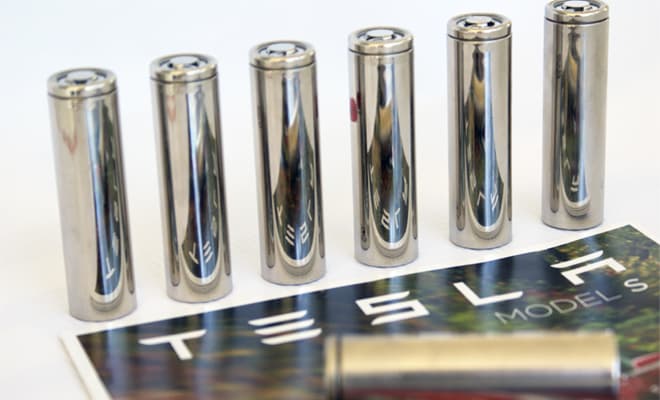
https://chargedevs.com/newswire/tesla-introduces-third-generation-battery-pack-technology/
John B. Goodenough was no stranger to brilliance; he developed in an environment where he was surrounded by it. In the 1970s he entered the University of Chicago’s physics department as a pupil of Enrico Fermi and John Simpson (co-leader of the Manhattan Project). He went on to work at MIT, and then the University of Oxford. Though, it was at the University of Oxford where John B. Goodenough found his calling. He began studying a crude lithium ion battery designed by Michael Whittingham. From here, John B. Goodenough designed a lithium-cobalt-oxide cathode structure, which massively improved on Whittingham’s design. Due to Goodenough’s structure, the battery was given a strong storage capacity and overall stability. Goodenough’s original structure and his later variations on it, remain in use today.
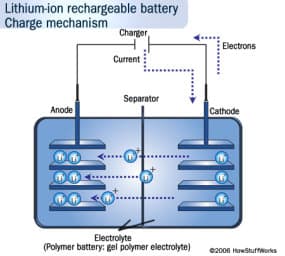
Like most batteries, the exterior of a lithium ion battery features a metal casing. On the interior, lithium ion batteries are quite unlike any other battery. It consists of three thin sheets, submerged in an electrolyte: a positive electrode, a negative electrode, and a separator. The positive electrode consists of Goodenough’s revolutionary lithium-cobalt-oxide structure. The negative electrode is built of carbon. The separator is made of a microperforated plastic, which separates the electrodes as ions travel through the electrolyte. While counterintuitive, ions leave the positive electrode for the negative electrode when gaining charge, and leave the negative electrode for the positive electrode when losing charge.
https://electronics.howstuffworks.com/everyday-tech/lithium-ion-battery.htm
The greatest benefit of lithium ion batteries is the uniquely high electro potential difference (voltage) between the positive and negative electrodes. This allows for them to store incredibly high densities of electricity, even at small scales. Additionally, they are great at holding their charge, and they can be discharged/recharged hundreds of times. Admittedly, there are shortcomings as well. Namely, lithium ion batteries degrade over time, they can be degraded even faster by extreme temperatures, and they can be expensive to produce (especially in large scale, such as for electric vehicles). There is also the small kink that they can burst into flames if they short circuit and ignite their electrolyte. Yet, it is worth reiterating: no other battery compares to their storage capacity. Moreover, as the years have gone on, the design of lithium ion batteries continues to be improved upon.
Despite the broad sweeping success of the lithium ion battery, and John B. Goodenough now being 97, he is still working on new ways to advance the design of lithium ion batteries. Early in 2020, John B. Goodenough filed a patent with the company Li-Ion for a new glass-based battery. It is supposedly more resistant to temperature changes, capable of triple the storage capacity of regular lithium-ion batteries, less susceptible to short-circuits, and more cost-effective. Time will tell if the battery lives up to the proposed capabilities.
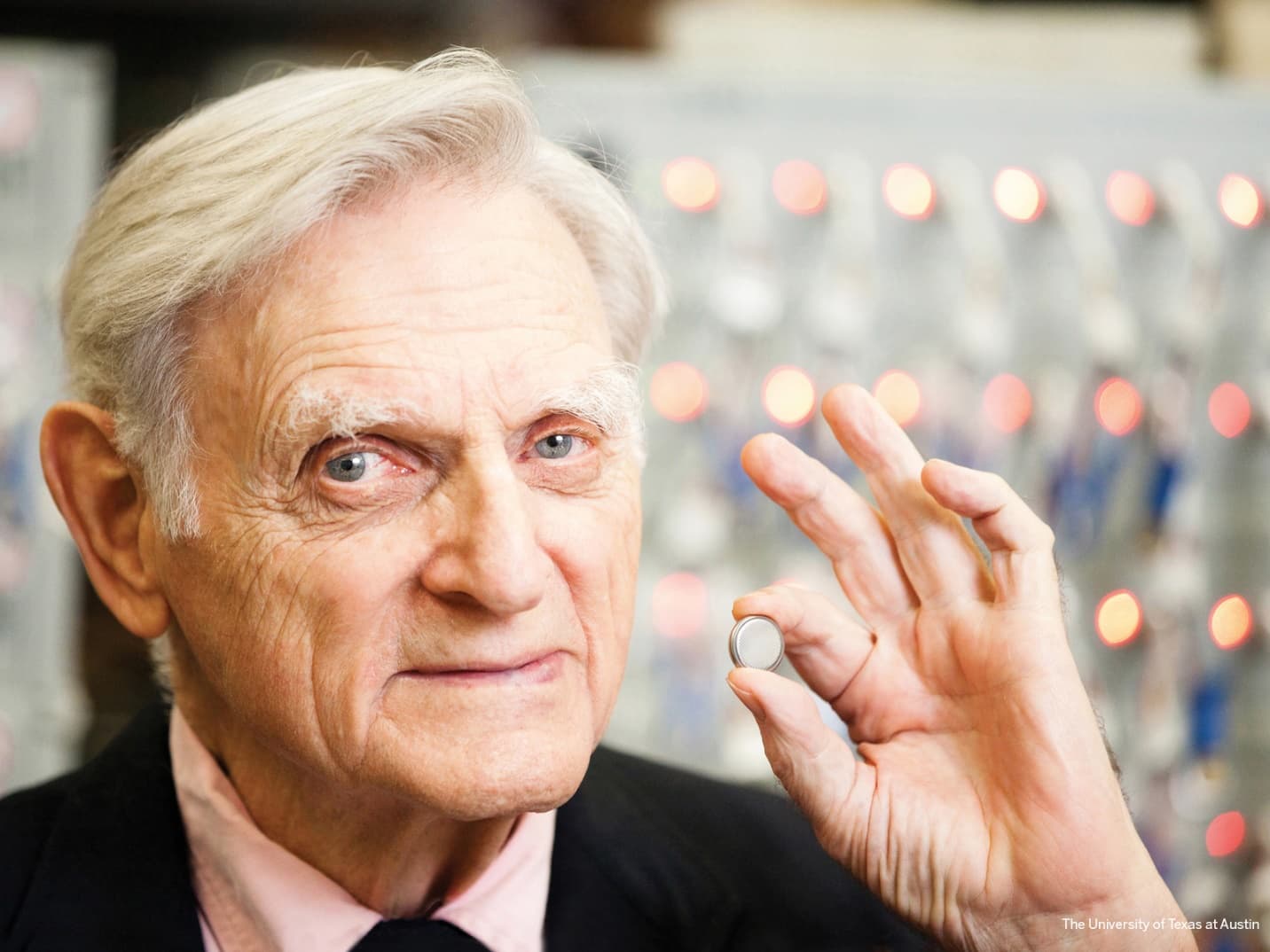
https://www.engr.utexas.edu/goodenough#:~:text=The%20Royal%20Society%20of%20Chemistry%20grants%20an%20award,both%20of%20whom%20worked%20on%20the%20Manhattan%20Project.
Lithium ion batteries are by no means a perfected technology. Its flaws are numerous, and John B. Goodenough very well could have an advancement on it soon. Regardless, lithium ion batteries are a critical component in our electronics, with massive societal impact. John B. Goodenough’s cathode design is featured in devices throughout the world. John B. Goodenough has been recognized by many award committees, including a Nobel Prize last year (alongside several other contributors). It is doubtful that anybody could contest the merit of his work. Lithium ion batteries are 100% good enough.
By: Christian Mueth