A Look Into the James Webb Space Telescope
A successor to the Hubble Telescope is about to join the scene. Originally announced in 1996 and scheduled for a 2007 launch, the James Webb telescope was finally completed this on August 28th, of 2019. Just slightly off schedule. Nonetheless, the James Webb telescope is a true feat of engineering. It’s an infrared telescope, set to orbit 1.5 million kilometers above Earth. It will be 100 times more powerful than the Hubble. More impressively: it’s about to become the most powerful telescope in the sky. With this title, it’s going bring forth numerous new discoveries, challenging the limits of what we know.
Image: NASA
So, what sort of discoveries might we expect? Well, sky’s the limit. As stated earlier, the James Webb Telescope is an infrared telescope, meaning it’s excellent at picking up long wavelengths. Scientists will study the atmospheres of planets for signs of life – specifically, for planets with carbon dioxide and methane. It will be able to study the origins of our universe, dating back to just 200 million years after the Big Bang. It’ll be used to study the formations of galaxies. It will study formation of planets. It will chart sections of the universe, faster than ever before. An interesting study has also been announced on how dark matter may affect gravitation between Draco and Sculptor dwarf galaxies.
What the James Webb Space Telescope is about to do can do pretty much speaks for itself. Though, there’s still the question I’m sure is all on your minds: how does the JWST do all of this? What makes it so much better than say, the Hubble, comes down to three factors: size, equipment, and temperature.
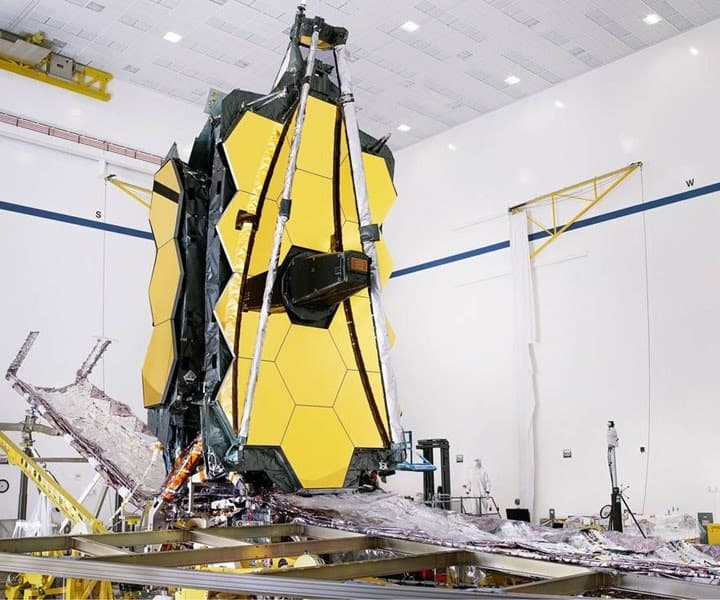
First off, size: the diameter of the JWST’s mirrors are 6.5 meters, as opposed to the Hubble’s 2.4 meters. This gives it a larger field of view, and greater sensitivity to longer wavelengths. Secondly, regarding temperature: NASA split the JWST into three subsections, all of which put emphasis on cryogenics to bring operating temperature down. It operates at “very cold 7 Kelvin” (NASA). This further allows it to read longer wavelengths. Of course, general advances in technology help too. The JWST has a massive solar shield to block out sunlight. It also has an instrument module (ISIM) which, among other things, can block out shorter wavelengths of light. With all of this combined, the JWST can read wavelengths of 30 microns. Hubble’s max? 1.8.
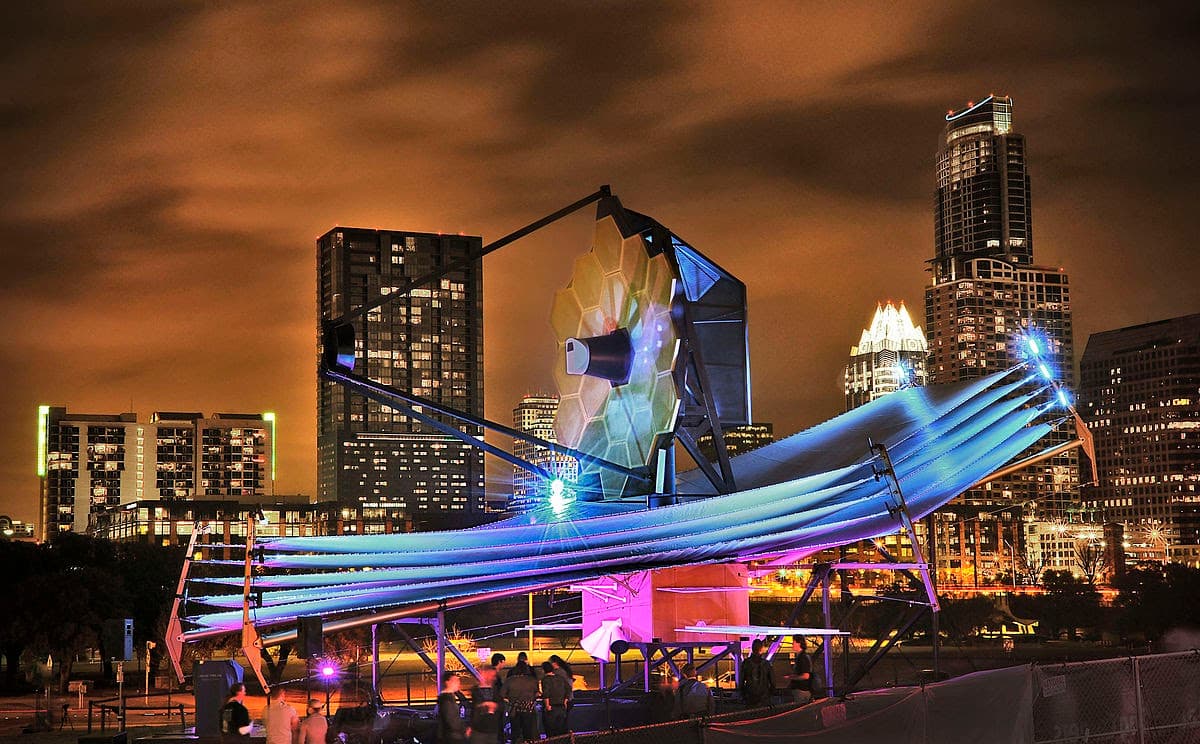
Impressive as all this is -- and, there’s plenty more where that comes from -- the most impressive feat of the JWST is that its design holds up at all. See, the JWST can’t fit inside a spacecraft. Its solar shield is the size “of a tennis court” (NASA), and its mirrors are also enormous.
Image: NASA
The solution? Northrop Grumman engineered a solar shield with five membranes, which fold out from the spaceship. This also applies for the mirror, designed with 18 pieces that will fold out its spaceship. These two folding processes will combine into the telescope’s final form. The concept sounds simple enough — but, the telescope’s pieces are delicate. This is especially true for the mirror, which is coated with a very thin layer of gold beryllium. It’s only 100 nanometers thick.
The folding ability has been the most critical part of JWST development, and also most prone to failure. If there’s any guilty party for all the delays, that is it. Thankfully, in May of this year the telescope finally passed “key milestone” tests in vacuums, meant to mimic extremities of space. NASA has only one shot at getting this right, and it looks like they will.
The JWST still doesn’t launch until March 31st, 2021 -- and it won’t be until 30 days after that when it will finally reach its destination. Though, similar to when 1990’s Hubble launched, the JWST is going to change the face of astronomy. Countless new discoveries are about to emerge. Insignifiant as the JWST may at first seem, it’s anything but. Thankfully that’s what telescopes are best at: taking the things that we might sweep under the rug and showing us how sweeping they really are.