Fusion and its Future
Renewable energy is one of the most important causes that is being worked on. However, a form of renewable energy sources that has yet to pan out is fusion energy. While fusion makes sense theoretically, there are practical challenges with fusion that have yet to be solved.
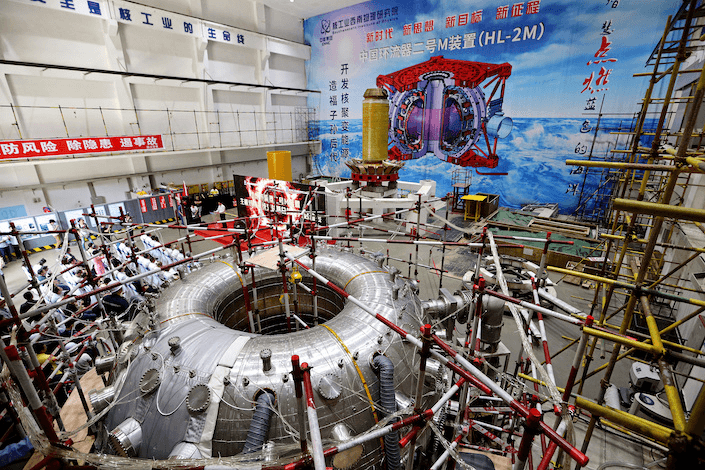
HL-2M Reactor - Nuclear Fusion At 100: The Hidden Race For Energy Supremacy | Hackaday
The way that fusion works is by harnessing the energy produced in the fusing of two atoms to form one (1). A massive benefit of fusion is that, unlike the radioactive products of nuclear fission, fusion does not produce radioactive waste as a product of the reaction. Rather, in addition to its energy output, it produces the useful element of helium. The general reactions being researched are between tritium (a hydrogen isotope with two neutrons and one proton) and deuterium (a hydrogen isotope with one proton and one neutron), due to reactions like deuterium-deuterium being untenable with current technology (1). Fusion limitations derive from the absence of a starlike gravity to compress atoms together. The temperatures required to overcome the atomic repulsion in fusion reactions are about 100 million Kelvin; this is six times hotter than the Sun’s core. In addition to extreme temperatures, atoms must be bombarded with ion particles, magnetic fields, lasers, and microwaves (1). All this energy input is what causes difficulty in getting a positive energy output.
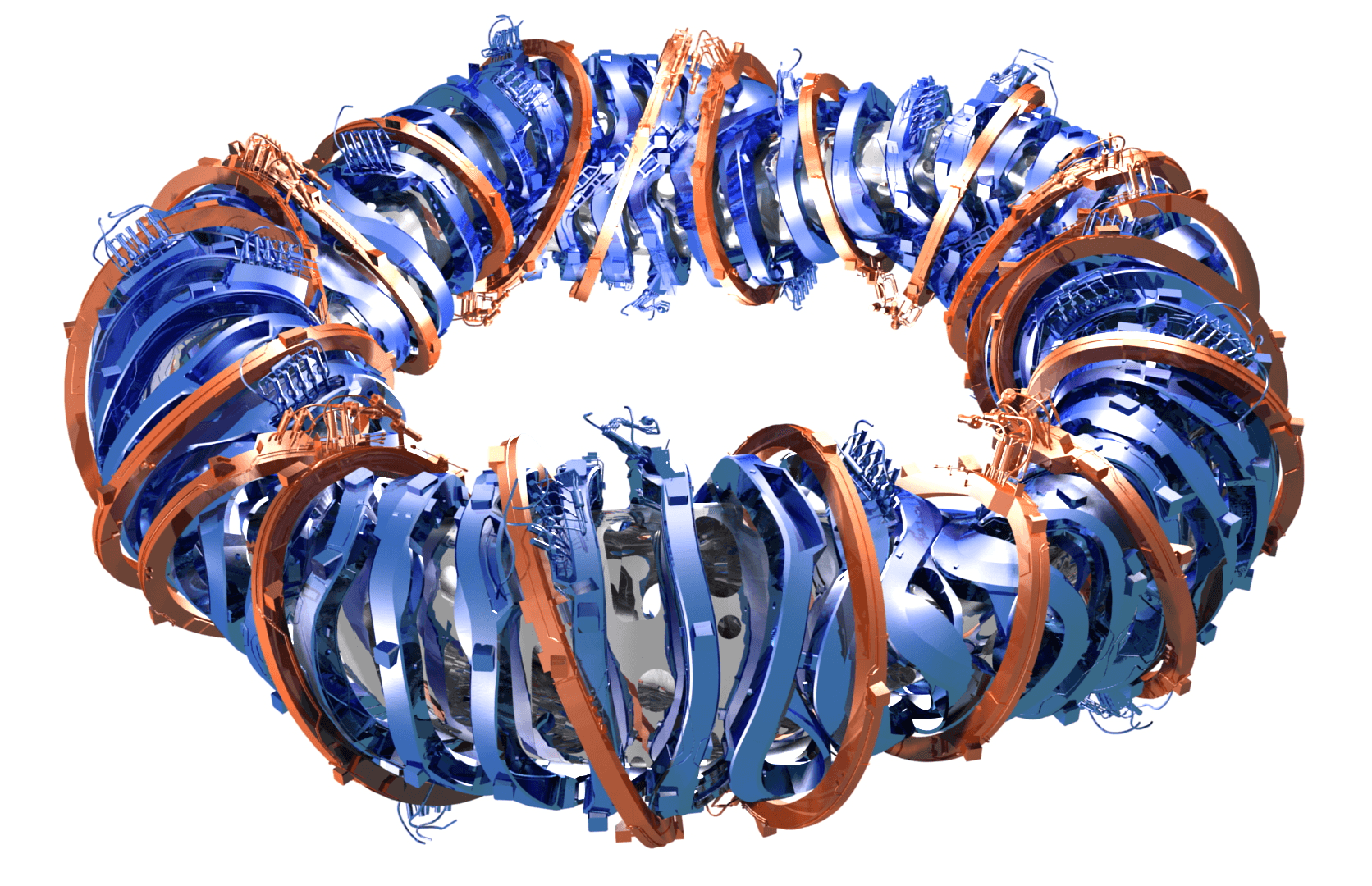
There are several designs that have been tested for fusion, such as z-pinch reactors and stellarator reactors. However, the primary design that is widely being funded by world governments is the tokamak. The tokamak is a donut of magnets, cryo-pumps, and energy redirection systems known as “diverters”, surrounding a reactor core. With the help of Lorentz force, they contort a magnetic field to a helix, with the intent of directing fusion plasma into a steady flow (2). The two fusion reactors of this breed that are currently being tested are China’s HL-2M tokomak and Germany’s W-X7 tokomak, which were put into operation in 2020. Further tests on these reactors throughout the 2020s will hopefully reveal new information on how to optimize the fusion process, and bring us closer to fusion with net energy gain.
Tokomak Magnet Design - Nuclear Fusion At 100: The Hidden Race For Energy Supremacy | Hackaday
In addition to massive fusion reactors, several other types of fusion have been theorized. These include cold fusion, and compact fusion reactors. Though, a common thread through all fusion reactors is that they have experimentally only achieved a net zero output of energy. One of the most famous examples of this is the ITER. This fusion reactor is claimed to produce ten times its energy input but, in practical application, it operates quite different. The design is projected to convert 150 megawatts from the electrical grid to 50 megawatts of power to start the reactor. It will then convert 50 megawatts of reactor start power into 500 megawatts of plasma power, and convert 500 megawatts of plasma power into 150 megawatts of power to go back into the electrical grid (3). More simply put, the reactor will take 150 megawatts in, and spit 150 megawatts out. A net zero output is quite a bit less than an output that is “ten times the input”.
Complex and entrancing as the fusion process is, current fusion reactors are functionally no different from a metal wire. While mere speculation, it is possible that there is a fundamental flaw on a thermodynamic level with trying to reproduce fusion at small scales. Perhaps a net energy gain from the reaction is unachievable, without the advantage of a starlike gravitational pull to motivate it.
The concept of clean reactors producing energy for the world is a beautiful one, and difficult to let go of. Fundamentally, the science is sound; fusion from stars in the sky are constant proof that fusion does work, and on mass scale. If there is a way to make fusion reactors become successful, it is worth it to continue trying. Thus, some of the brightest minds in science are chipping away at the problem, with the hopes of cracking it. Though, whether their intellectual challenge to make fusion successful has potential, or is merely the modern equivalent of Isaac Newton chasing the “philosopher’s stone”, remains to be seen.
Sources:
Conditions for Nuclear Fusion - How Nuclear Fusion Reactors Work | HowStuffWorks
Nuclear Fusion At 100: The Hidden Race For Energy Supremacy | Hackaday
How close are scientists to developing fusion energy? — WHYY