Radio Transmission: How Does it Work?
Radio waves permeate our universe, and radio technology is used all throughout our daily lives. Moreover, radio technologies were essential in the developmental stages of our current communication technologies. Nevertheless, the science behind the transmission of radio waves often goes untouched. Let’s look a bit into what radio waves are, and how radio transmission operates.
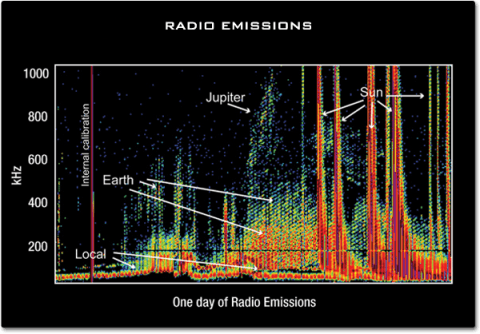
Radio Waves | Science Mission Directorate (nasa.gov)
Radio waves are a form of electromagnetic energy along the electromagnetic spectrum. Specifically, they are among the longest wavelengths of electromagnetic energy. The radio wave was first discovered in the 1880s by Heinrich Hertz. He was doing an experiment with a high-voltage spark gap connected to an induction coil, and a second spark gap connected to a wire antenna (1). When he sent electricity through his first spark gap and induction coil, Hertz saw something interesting. A second spark occurred a bit away, within the second spark gap that was connected to his antenna (1).
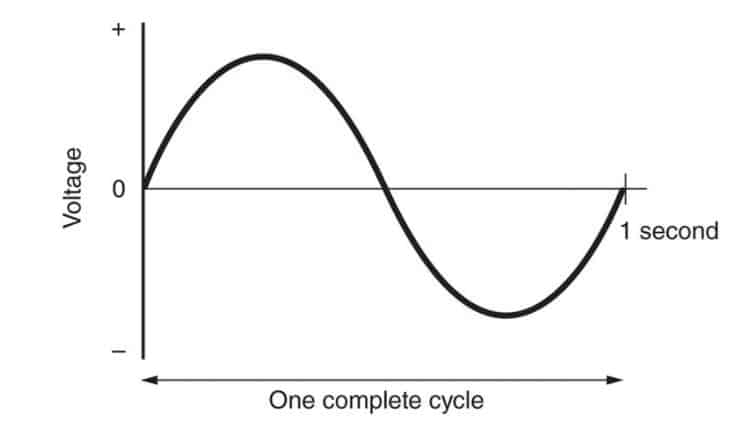
Since Hertz’s discovery, subsequent experiments modeled out the behavior of radio waves (1). It was realized that radio waves’ long electromagnetic wavelength allows them to transmit low amounts of energy over long distances. Furthermore, such energy could be used as a way of transmitting information and data. It is for this reason that the “frequency” of radio waves — the number of wave cycles per second (2) — bear the name “hertz”.
Bandwidth, Frequency and Data Rate | Home (ad-net.com.tw)
Radio waves are produced any time that a flow of electrons, or electric current, is formed. They can be generated by something as simple as intermittently shorting the terminals of a 9-volt battery with a piece of metal (2). These quick changes in electric current, or “pulse modulations”, will induce a magnetic field in the air. This causes the formation of electromagnetic radio waves (2). While such a simple signal can only be read as random static by a wire antenna, more advanced circuitry turns radio waves into a very useful tool.
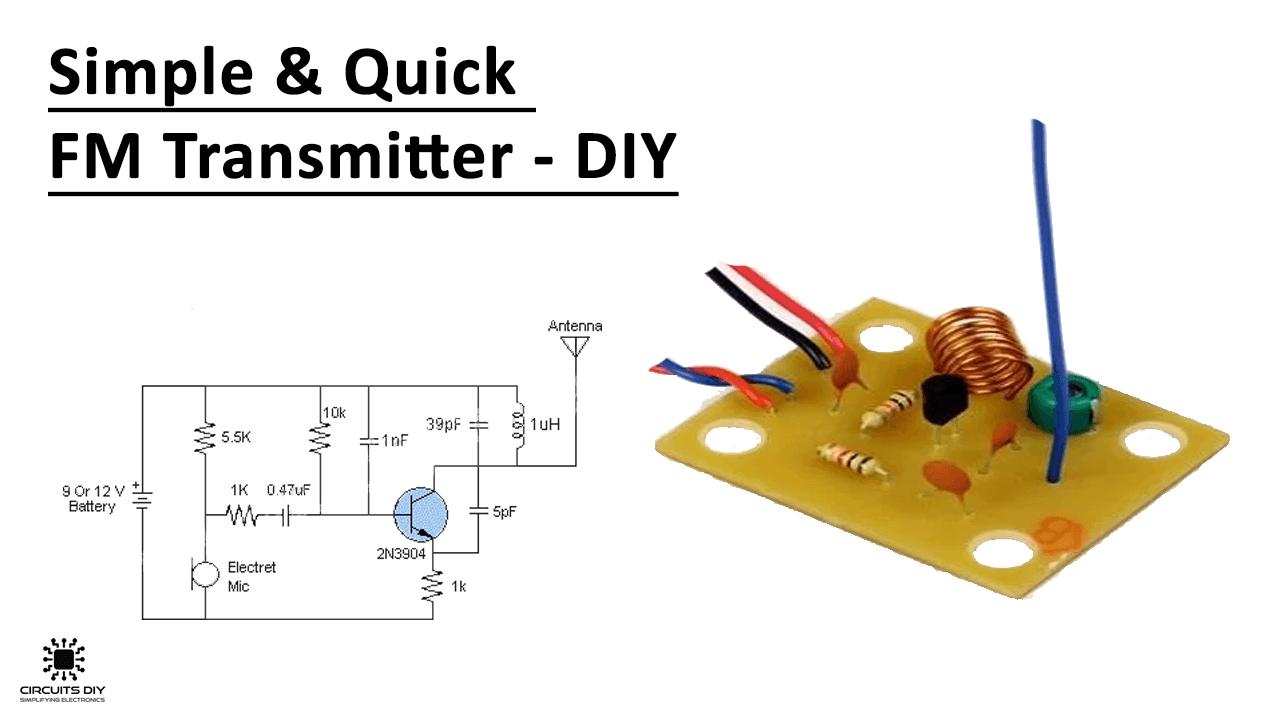
In commercial radio transmitters, several electric components are used to enhance and modulate electric radio wave signals. These components include capacitors, resistors, inductors, transistors, and antenna wires (2). Capacitors store and release large capacities of electric charge, via storing large amounts of electrons between a dielectric material. Resistors use resistive metals, to slow down electric currents. Inductors use magnetic fields to induce stronger electric currents. Transistors allow for quick transitions in “voltage”, otherwise known as electric potential energy difference. Transistors are what help produce organized radio waveforms. Antenna wires provide terminals between a radio transmitter and radio receiver (2). Out of all these components, the transistor may be the most important. The organized waveforms created by transistors allow radio waves to be translated and amplified into logical signals by radio receivers (2), such as sound.
Simple and Quick FM Transmitter - DIY (circuits-diy.com)
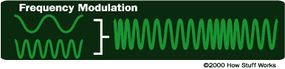
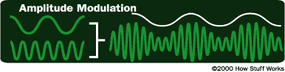
Radio waves are transformed in a variety of ways while being transmitted and received. This is so that many waves can travel long distances, without getting tangled with one another (4). The two most common ways of radio transformation are frequency modulation (FM) and amplitude modulation (AM). In frequency modulation, the frequency of a radio wave is shifted (2). Shifting frequency involves changing the rate of a radio wave’s cycles per second. Amplitude modulation involves shifting the amplitude. Amplitude modulation changes the peak voltage of a radio wave signal. Radio transmitters are often where the modulation of radio waves is performed (5). Radio receivers are then tuned to the desired FM or AM channel, where they will convert a modulated radio signal back into their original forms (5).
How Radio Works | HowStuffWorks
Radio technologies are visibly present in our day-to-day activities, but the underlying theories to them remain quite invisible to the naked eye. Even in this article, we have only scratched the surface of the subject. Simply put, radios are complex. Despite this, they are well worth learning about. The depth of science involved in the innocuous radio serves as a reminder: never stop being curious about the technologies encompassing the world around us.
Sources:
Radio Waves | Science Mission Directorate (nasa.gov)
How Radio Works | HowStuffWorks
Bandwidth, Frequency and Data Rate | Home (ad-net.com.tw)
Simple and Quick FM Transmitter - DIY (circuits-diy.com)
Radio and digital radio | How it works | AM and FM compared (explainthatstuff.com)