Putting the Microwave Under a Microscope
The microwave oven represents a small part of our lives, when it’s part of it at all. It’s the ten second transformation from cold, stale leftovers, to warmer, soggier leftovers. That said, it provides convenience; comfort. Moreover, the story behind the microwave oven is larger than life. There is deep meaning behind its quick-fix pizza rolls. Let’s get rolling, shall we?
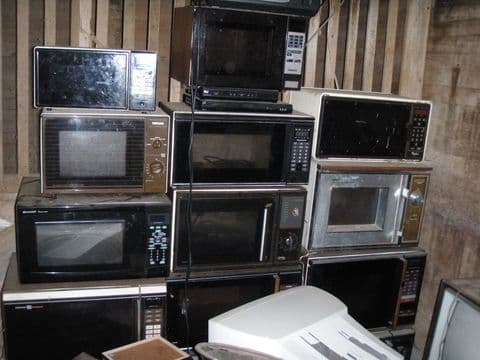
Stack of Microwave Ovens: https://www.popularmechanics.com/technology/gadgets/a19567/how-the-microwave-was-invented-by-accident/#:~:text=The%20microwave%20is%20beloved%20for%20its%20speed%20and,magnetron%20and%20suddenly%20realized%20his%20snack%20had%20melted.
The microwave oven was invented by an engineer by the name of Percy Spencer. As one may guess of an inventor, Percy Spencer a bit of a genius. During WWII, Percy Spencer worked for Raytheon, designing improved fuses, detonators, and radar magnetrons (for radar sets). It was in 1946, when working on one of his radar magnetrons, which was particularly significant. By chance, Percy Spencer went to grab peanut cluster bar from his pocket, for snack — however, he found that it was melted. Naturally curious, Spencer knew he needed to do more testing. An egg was placed under the magnetron, only to explode in his face. There was another test with popcorn; it was no less catastrophic.
From here, Spencer and the rest of Raytheon went on to design the microwave oven. Introduced in 1947 as the “Raydarange”, the first microwave oven was massive. It was 1.8 meters tall and weighed 340 kg. It also guzzled 3 kw during operation and had to be water cooled. It was mainly marketed to airlines, and was a bit of a dud. The technology didn’t hit the consumer market until 1955; even then, it cost $1,295 (nearly $11,000 in today’s money). Yet, as the years went on, the technology would eventually become more affordable, and prevail.
So, how exactly does a microwave work? To begin, microwaves are a form of radiation on the electromagnetic spectrum, weak enough to not pose major danger to living cells. That said, microwave radiation is still a form of energy. Thus, it’s great at accelerating molecules, such as water molecules, upon contact. Better put, microwaves are great at generating heat in molecules. It is through this mechanism that the microwave oven heats food (which often consists of high water content). However, to generate microwaves, the microwave oven must go through a bit of a process.
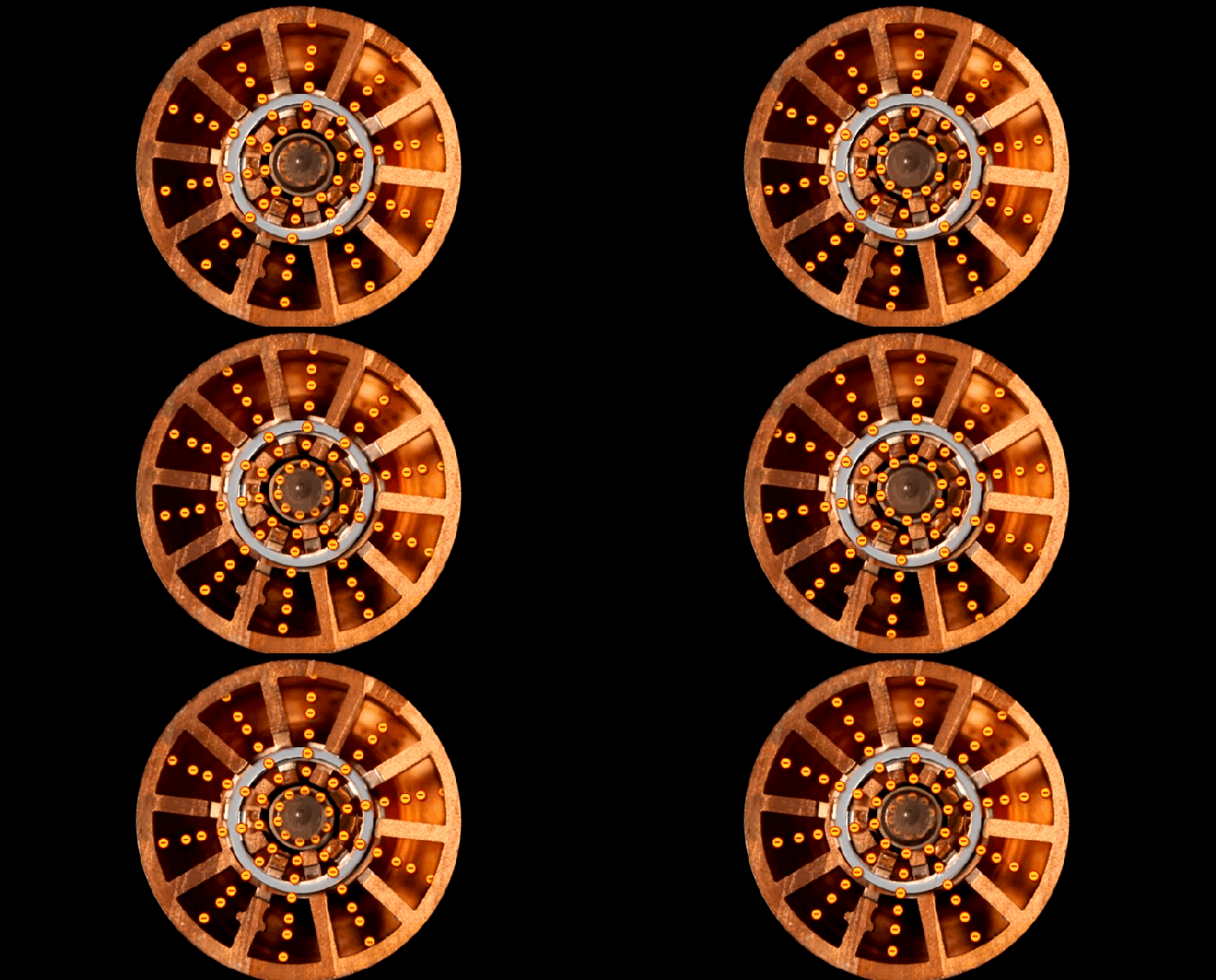
Magnetron: https://www.businessinsider.com/how-do-microwaves-work-2014-6
A transformer takes electricity from the wall and converts it to high voltages (often from 120V to over 4,000V). There’s then a device called a “magnetron”, with a filament at its center that is heated up by these high voltages. Electrons are expelled and move toward positive terminals at the magnetron’s edges. However, these electrons circle back toward the magnetron’s center, due to magnets near the positive terminals. This turns to a cycle of oscillations. An energy frequency of 2.45 gigahertz emerges: microwaves. It’s from this that things can finally be quickly heated.
It is easy to handwave the microwave as being a simple kitchen appliance. However, this is a testament to the microwave’s ease of use and ingenuity, more than anything else. The microwave’s status as a kitchen staple comes from a mixture of experimental accident, and chaotic genius; this shouldn’t go overlooked. Without the microwave, the world just wouldn’t be the same. How else would we get our quick-cook oatmeal in the morning?