DevOp Engineer: The Most In-Demand Software Developmental Team Role
While system administration, programmers, and developers can all work on the same project under the same roof, there is not necessarily a seamless flow of communication and work between these parties. This division of labor is painful and can harm the effectiveness of the product. Users of the 21st century expect applications that are constantly getting better and more efficient. A DevOp is the clear and modern solution, for organizations with 20/20 vision. In this article, we will go over the fundamentals of what a DevOp is, how a DevOp can benefit your product, and the qualities of DevOps.
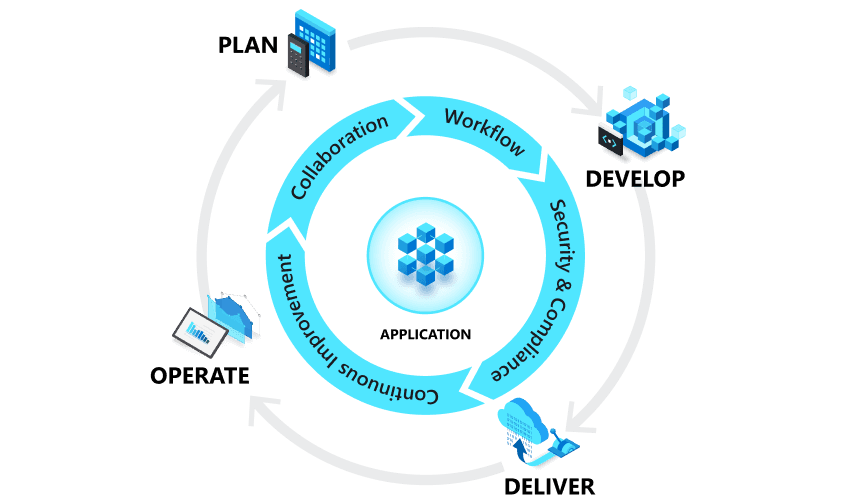
What is DevOps? DevOps Explained | Microsoft Azure
People often wonder: what Is a DevOp? A DevOp is the merging of development and operations. It ultimately makes software development, upgrading, and release as seamless as possible (1). DevOps reduce the complexity of these processes, closing the gap between new application development and current application reliability. These talented individuals are constantly adding to their skill sets on top of previous experience to offer a broader hand to the project.
A good DevOp will be able to combine application development aspects like library updates or data organization with foundational communication and coordination skills. This cultivates a beautiful, holistic flow within software development. You might call a DevOp the glue that binds the software engineering and IT of a project together. Continuous integration, as well as continuous delivery, make the DevOp a unique role. While traditional software engineering works in linear stages, DevOp engineering runs an ongoing feedback loop to maintain flawless flow (1). Through automation, this loop of unification is made up of development life processes like coding and deployment maintenance.
The introduction of new tools and methods makes a DevOp the ultimate integrative engineer, combining management, application stability, and code. An especially valuable skill that DevOps bring to the Software Development Team is improving and redesigning IT infrastructure (1). Sluggishness in a team’s core infrastructure might obstruct a software’s full potential. The improvements and redesigns a of a DevOp improve collaboration, allowing releases to come out quicker.
DevOps automate crucial, yet repetitive and time consuming tasks. A DevOp can create software plugins that lighten the software team’s workload, so they can spend energy on bigger things (2). They also manage IT Projects. This allows DevOps to designate the when, where, how, who and what of IT projects, crucial to your software. In this way, DevOps determine the reliability of current software developments.
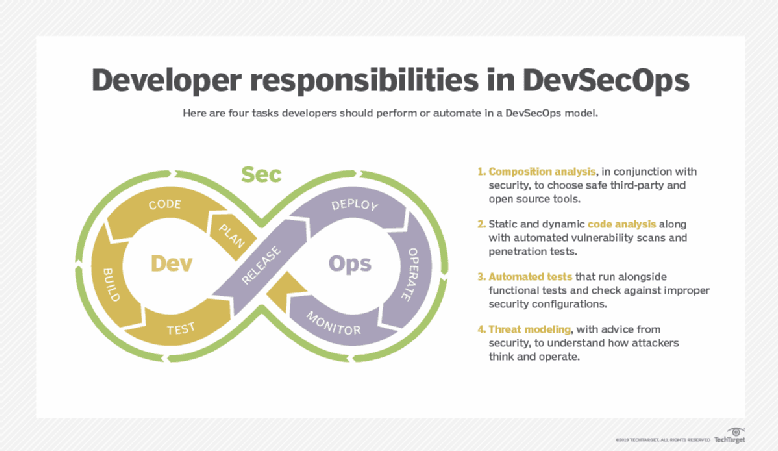
What Is DevOps? The Ultimate Guide (techtarget.com)
Another DevOp ability is evaluating system and software reliability, through performance testing and benchmark efforts. This is indispensable. Adding to this valuable ability is their creation of SecDevOps. SecDevOps are security processes, crucial to DevOp organized processes (2). These include schedules, automation, and infrastructure design. Another way SecDevOps help is by monitoring and providing feedback on TTD and TTM TTD (time to detect errors), and TTM (time to minimize errors). This removes hidden drains in the software release process.
A DevOp optimizes release cycles, so new releases can get to the market faster. One of the main tools a DevOp uses to do this is automation. As a result of their work, releasing frequently is easy. DevOps deploy releases many times a day, without users ever noticing. Thus, your software development and IT teams have more time and energy to focus on creativity, modification, upgrades, and groundbreaking improvements or changes. Various IT Functions and developmental strands can also work coherently with a DevOp. Each new and unique bit of development will build on top of the other, to create a coherent experience for the user.
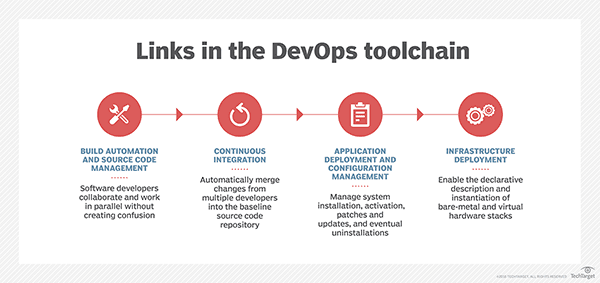
A good DevOp is fluent and extremely efficient in tools of all different areas. For automation, tools like Jenkins and Bamboo are a must (3). All DevOps should exercise extensive knowledge in source code management tools, like Git. Software like Github and Bitbucket is important for a DevOp to sufficiently perform tasks with repository hosting. For containerization, a DevOp is expected to know Docker and Kubernetes well, just as they should know Puppet, Enterprise, Ansible, and Chef for configuration management (3). Tools to monitor software efficiently include Nagios and Raygun, and for project management your DevOp should be familiar with software solutions like Jira and Trello (3).
What Is DevOps? The Ultimate Guide (techtarget.com)
While DevOps will optimize and automate most if not all software testing, this is not their only function. DeVops are especially key, in their ability to software test (2). When running into a problem or needing to troubleshoot, the ability to manually test software is extremely handy. They have thorough understanding of diction and methodology, in the flow of software development. Successful DevOps know the importance of always looking for new ways to refine the development life cycle.
There’s a motivating philosophy, behind DevOp work. It walks a fine balance between two skills, expanding upon software development and IT operations. Additionally, the field of DeVops is always open to new players. Previous software engineers and IT staff who develop their skillset and cultivate a deep knowledge make excellent DevOps. Growing a multifaceted skillset is a foundational tenet for potential DevOps. They embrace opportunities to learn and continue fine-tuning themselves. Over the course of their careers, they develop good management, organization, and communication skills.
A DevOp is often the ultimate head manager of development projects, release dates, and sustainability within product updates. It is absolutely crucial they are efficient in management and organization. Schedules and team coordination will be primary concerns for a DevOp. Thus, they must also be friendly and well-versed communicators. The most efficient and organized manager cannot improve coordination within a team, if they are not an excellent communicator themselves. In a world growing faster in pace by the second, the contributions of a DevOp are not merely a luxury. They are an absolute requirement. By merging a developer's need to introduce new features and an IT operator's need to preserve stability, DevOps create seamlessness within any software project.
Sources:
What is DevOps? DevOps Explained | Microsoft Azure
What Is DevOps? The Ultimate Guide (techtarget.com)
20 Best DevOps Tools for 2022: Git, Docker, Jenkins & More | Simplilearn