The Future of Space Propulsion
The future of flight is in a complicated place right now. Spaceflight? Even more so.
Currently, a 35-million-mile trip to Mars will take between six to nine months. It is often wondered who the first person will be to walk on Mars. Though a better question is whether anybody will be able to walk at all, after a trip like that. Worse, once Mars’ first earthling tourists arrive, they’ll still have a six to nine-month trip back to look forward to.
If we want to make repeat trips to Mars and throughout our solar system, six-month trips from chemical rockets will be prohibitive. The need for a faster form of spaceflight is unavoidable. Thus, I am going to discuss several propulsion systems that may dominate the future.
Photon Propulsion:
Photon propulsion works by bouncing photons off a solar sail. The resulting force then accelerates the spacecraft. Methods of photon propulsion have been proven successful several times before. Perhaps the most notable is JAXA’S IKAROS. It was the first successful solar sail in space. (JAXA)
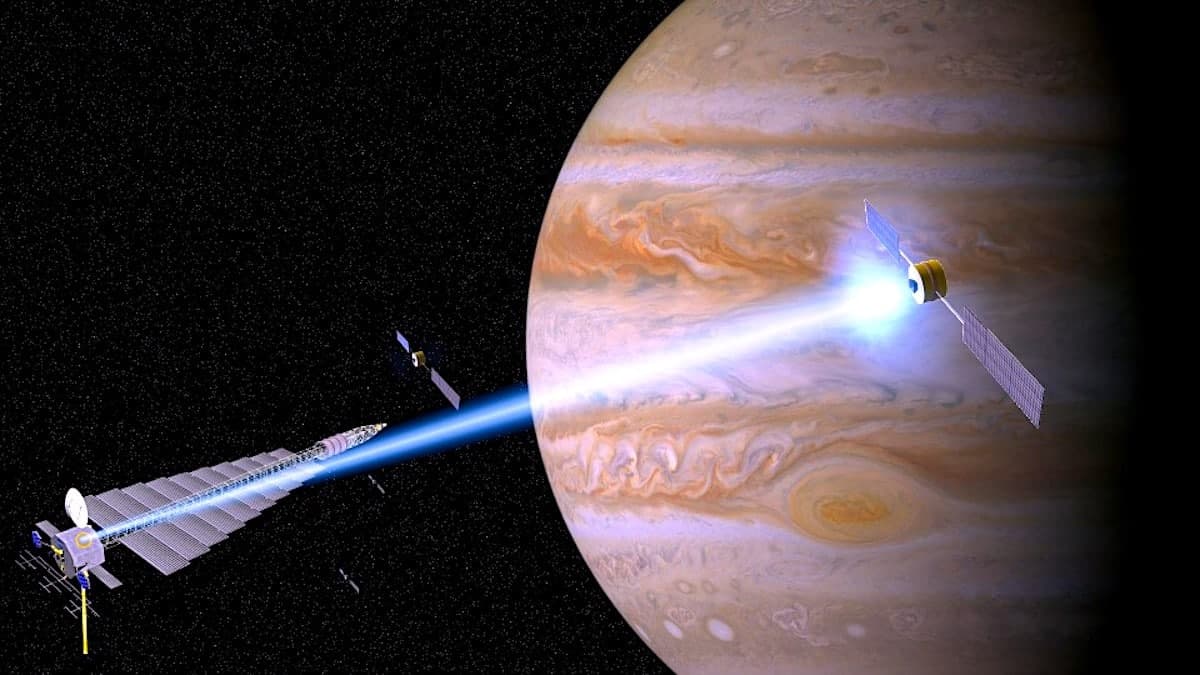
Robert Lubin, a professor from the University of California, proposed accelerating a light sail via a laser. With this method, he ambitiously predicted being able to send “a 100 kg craft to Mars in just three days” (Hall).
One difficulty is that it would be difficult to maneuver such crafts around debris. Moreover, it is best suited for probes, and unlikely that such a propulsion system could be used for large loads.
Plasma Propulsion:
The Variable Specific Impulse Magnetoplasma Rocket (VASIMIR for short) is a plasma-based propulsion system, developed by Ad Astro. The big headline for this technology is that it could get us to Mars in “39 days” (Skocik).
The VASIMIR heats up noble gases argon and pushes them through magnetic inductors. Following this, electrons are knocked from the noble gases, and they’re turned to a plasma. Finally, it uses magnetic inductors to generate a magnetic field, accelerating the plasma — thus, accelerating the rocket. (NASA)
One of the biggest problems with the VASIMIR is its power requirements. According to Robert Zubrin, “a nuclear reactor system with a power of 200,000 kilowatts and a power-to-mass ratio of 1,000 watts per kilogram. In fact, the largest space nuclear reactor ever […] had a power of 10 kilowatts and a power-to-mass ratio of 10 watts per kilogram.” (Skocik)
Their last update had them on course for a 100 hour test in 2018. Since then, little news has come from it. Nonetheless, the technology is one that might become prevalent in the distant future. (Wang)
Ion Propulsion:
Ion propulsion is a compelling form of future propulsion, due to the high speeds it can reach. It can achieve 90% efficiency, whereas chemical propulsion systems can only reach 30% efficiency. They can achieve top speeds of 200,000 mph. They work by bombarding a noble gas (commonly xenon) with electrons, which creates positive ions. These ions are then sent through a metal grid, giving acceleration.
There are many ion propulsion systems that have been introduced over the years, the most prominent being the Hall thruster. The technology is constantly being evolved. A problem faced by Ion propulsion is that it has extremely low acceleration. Thus, it works best for long trips where a minimum amount of fuel usage is desired. X3 thruster. It is currently exceeding all its tests. 105 kW power, 5.4 Newtons of thrust. (Nowakowski) The biggest advantage of the X3 engine is that it’s a three-channel nested system. Its biggest problem: it is extremely bulky, compared to its counterparts.
Nuclear Thermal Propulsion:
NTP uses a fission reactor to super-heat hydrogen gas which then escapes through a small nozzle to generate thrust. This technology spans back to 1942, from Enrico Fermi experiments. Out of all the listed propulsion systems, NTP is most likely to overtake chemical rockets soon. NASA has stated, “NTP is a viable and powerful option to explore Mars and other destinations.”(NASA)
The U.S Government recently poured 100 million in researching NTP. NASA has partnered with BWXT and is projecting a launch in 2024 (Wang). Proposed rockets would be 107 times more energy dense than chemical rockets, and half as heavy (Tarantola). It is estimated that they could reduce travel time to Mars by 20-25%. Another advantage is that a Nuclear engine could abort a mission two months in, if needed (Bennett). The biggest drawback is radiation caused by its nuclear power source, similar to the VASIMIR.
Conclusion:
Based on history, predicting the future rarely works out. This is especially true when it comes to technology. It is quite possible that none of these propulsion systems will be used for trips to Mars, and something entirely different will dominate the future.
Even if one of these propulsion systems do find dominance, chemical rockets will still have a role in spaceflight. With Ion propulsion and VASIMIR, for example, chemical rocketry is necessary for launch.
Nevertheless, it is intriguing to think about what alternatives to chemical propulsion humans might use to travel the solar system. As humanity reaches higher and higher velocities with its propulsion systems, we will edge ever closer to becoming a star faring civilization.
Sources:
Bennett, Jay. Popular Mechanics. (2016) Photonic Propulsion could send spacecraft to Mars in 3 days. https://www.popularmechanics.com/space/deep-space/a19604/nasa-physicists-say-photonic-propulsion-could-send-a-spacecraft-to-mars-in-3-days/
Bennett, Jay. Popular Mechanics. (2018) NASA’s Nuclear Thermal Engine. https://www.popularmechanics.com/space/moon-mars/a18345717/nasa-ntp-nuclear-engines-mars/
JAXA. (2020) https://global.jaxa.jp/projects/sas/ikaros/topics.html
Jones, Brad. Futurism. (2017) New Ion Thruster Breaks Records. https://futurisnasas-new-ion-thruster-breaks-records-could-take-humans-to-marsm.com/
NASA. (2016) Ion Propulsion. https://www.nasa.gov/centers/glenn/about/fs21grc.html
NASA. (2018) Nuclear Thermal Propulsion: Game Changing Technology for Deep Space Exploration. https://www.nasa.gov/directorates/spacetech/game_changing_development/Nuclear_Thermal_Propulsion_Deep_Space_Exploration
Nowakowski, Tomasz. Phys.org. (2018) Will the X3 thruster propel us to Mars? https://phys.org/news/2018-02-x3-ion-thruster-propel-mars.html
Skocick, Collin. Space Flight Insider. (2017) Earth to Mars in 39 Days. https://www.spaceflightinsider.com/conferences/vasimr-plasma-engine-earth-mars-39-days/
Tarantola, Andrew. Gizmodo. (2013) How NASA's Nuclear Rockets Will Take Us Way Beyond Mars. https://gizmodo.com/how-nasas-nuclear-rockets-will-take-us-way-beyond-mars-5992441
Wang, Brian. Next Big Future. (2017) Vasimir Plasma Rocket Targeting 100. https://www.nextbigfuture.com/2017/02/vasimr-plasma-rocket-targeting-100.html