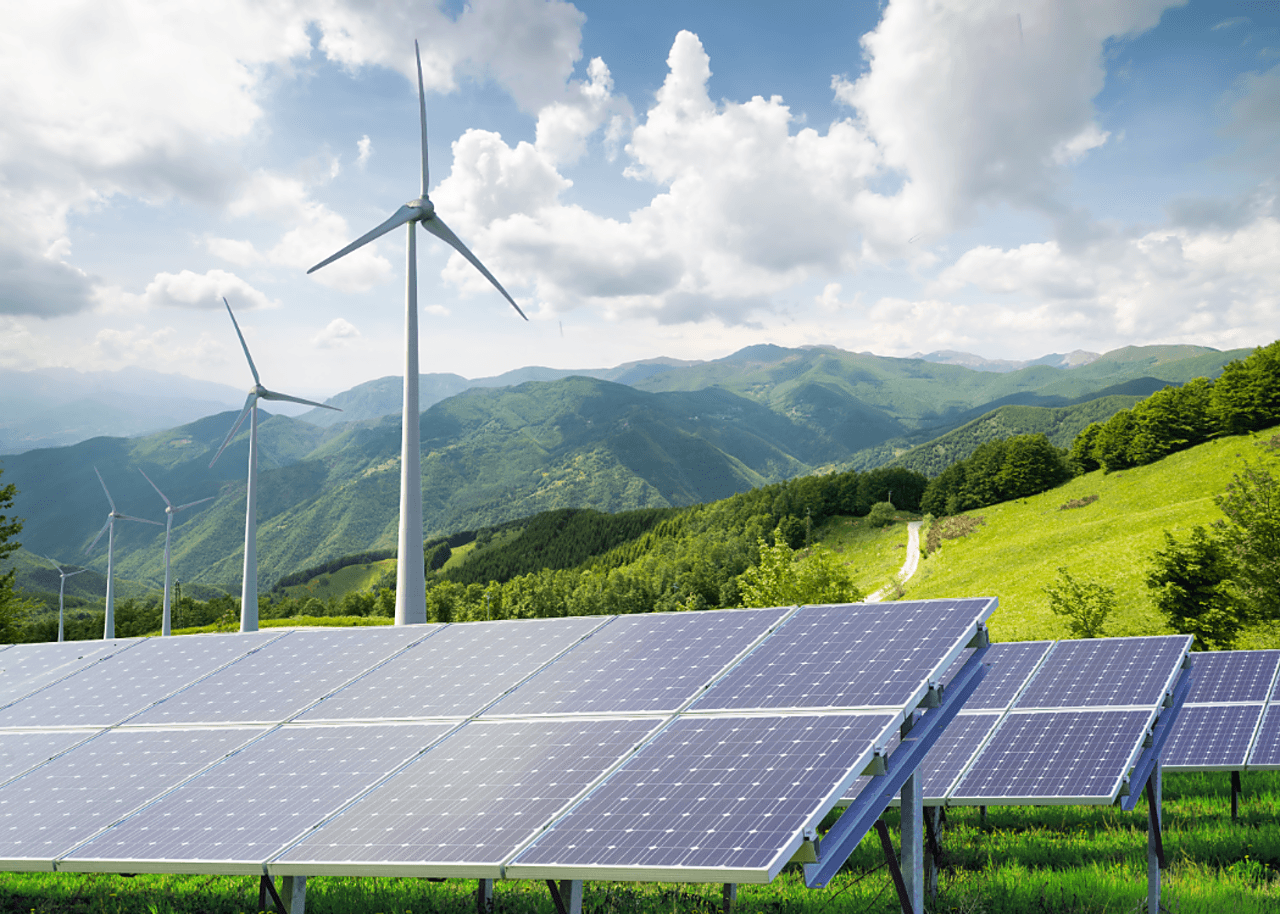
Solar Panels: The Generation of Regeneration
One of the greatest threats to our civilization is ourselves. More specifically, it is the carbon emissions that we generate. In all fairness to ourselves, immense carbon generation is only to expected from a society of carbon-based lifeforms. Nevertheless, regenerative technologies are the way of the future, with the potential of bringing us to carbon neutrality. Solar energy, in the form of solar panels, is an essential piece of this.
The function of solar panels is to harness energy from the Sun. Specifically, it harnesses photonic energy by having photons knock electrons from its solar cells. This knocking of electrons creates an electric polarization; more precisely, electric charge in the form of electricity. The material used in solar cells to accomplish this is generally a thin film of silicon atoms, due to its accessibility (1). Though, there are rarer metals that could give a better performance than silicon (namely, tungsten). The solar cell film is placed between polarized material meshes to encourage a buildup of charge. These materials are boron for a positive charge and phosphorous for a negative charge (1). There are also conductive metal wires along the solar cells, to transmit resulting electricity. Finally, there is glass plating overtop solar panels, to contain photonic energy and protect the solar cells.
Advances in solar cells are continual. Currently, researchers have achieved silicon films that are as thin as 1.3 microns. Other forms of solar power technology are also being developed, such as concentrated solar power and thermal solar power, which stand to have higher energy efficiency (1). Due to the silicon being second to oxygen as the Earth’s most abundant molecule, and solar panels having relatively minimal issues on the environment, these advancements are unlikely to stop any time soon.
Solar Panels - How Do Solar Panels Work? (gizmodo.com.au)
Solar energy is spreading throughout the world as a wildfire. They are being installed five times faster than coal power stations, and twenty times faster than nuclear power stations. In Australia, new power production facilities are exclusively solar or wind farms. Australia’s new initiative also comes with good reason, as sunlight from the Sun on their land potentially has 20,000 times the energy as the USA is able to produce from gas, oil, and coal (2). Due to technological advancements and government regulations, solar cells have gotten cheaper to produce by 99% since the 1980s (3).
While work is still to be done to make solar cells more effective at energy production, solar technology has already come a long way from where it was during its inception. Renewable energy only stands to grow, as the globe becomes more heated from immense carbon emissions. Solar panels are not the entire solution to the energy question, but they are an integral part of it.
Sources:
How Do Solar Panels Work? | Photovoltaic Cells | Live Science
How Do Solar Panels Work? (gizmodo.com.au)
Solar panels now cost less. Thank government policy. - Vox