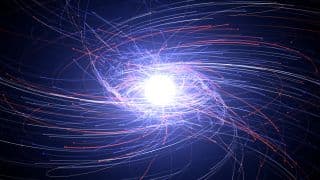
The Mysterious Matter of Antimatter
The world that humans commonly interact with is comprised of ordinary matter. Such matter consists of atomic particles like protons, electrons, neutrons, and (presumably) neutrinos. A common debate in science surrounds the question of dark matter, which is observed to influence gravitational behavior at galactic scales. It is often questioned whether dark matter should be considered “matter” at all. Though, a mystery that often goes overlooked concerns a different type of matter: antimatter. Antimatter has been proven to exist via various experiments with particle colliders. Based upon current models, ordinary matter should exist in a universe with an equal amount of antimatter. Yet, current astronomical tools detect much less antimatter throughout the universe than current models predict.
The Universe's Dark Secret: Where Did All the Antimatter Go? | Space
Antimatter is an incredibly interesting phenomenon. The mass of an antimatter particle is identical to its normal matter counterpart. Though, the charge is often equal and opposite (1). For example, positrons have the same mass as electrons, but the charges are different. Electrons have a negative charge, whereas antielectrons have a positive charge. Additionally, a lepton or baryon number is assigned to antimatter particle that is opposite to that of a matter particle. Positrons are given a lepton number of -1, whereas electrons are given the lepton number of +1. In the case of a neutron, which always has a neutral charge, an antineutron has the same “charge” and merely carries an opposite baryon number. Interestingly, antimatter also exists among all known fundamental particles, including exotic particles like a muon or a tau (1). When matter and antimatter interact, it is explosive and often results in photonic energy being emitted. Going back to the electron and antielectron, they tend to emit two photons when they collide. Granted, higher energy collisions can yield different particles than just photons.
Despite much being known about antimatter behavior, the observed amount of antimatter defies expectation. Due to interactions between matter and antimatter being highly energetic, astronomical activity is of a much lower energy than expectation (2). This immense asymmetry defies what many might expect. Several explanations have been proposed. One possibility is that antimatter dominates a distant and unobservable portion of space, which is essentially lost to the portion of the universe that consists of matter (3). If the force of gravity can be described on quantum scales, it could also be that antimatter dominated regions of space follow different rules of gravity, in the form of “antigravity” (3). This could facilitate the matter/antimatter disconnect.
The leading explanation for matter and antimatter disparity comes from CERN. There was an observed 1% difference in the decay of muons vs antimuons from mesons. Such a difference in decay rates could have led matter to dominate at the inception of the universe. Therefore, the observable matter in the universe could very well just be the 1% of matter that remains from antiparticle and particle interactions. While this explanation is satisfying, there is still skepticism to be had. Antimatter and matter interactions outlined by the standard model and the simplest Feynman diagram models could lead one to believe that there should be no difference in percentages. A 1% difference can also be accounted for by an overlooked experimental error in the particle accelerator. Furthermore, only so many experiments have been carried out. That said, when one considers that there are always quantum probabilities involved in particle/antiparticle interactions (Feynman diagrams even acknowledge this), a random cosmic coin flip could in fact explain the mystery.
The universe contains countless secrets, which are still yet to be uncovered. While questions of our universe’s antimatter and matter is still up in the air, there are at least very real and reproducible explanations. Here is hoping that an explanation is cemented over the coming years.
Sources:
The Universe's Dark Secret: Where Did All the Antimatter Go? | Space
The matter-antimatter asymmetry problem | CERN (home.cern)
Where’s All The Antimatter? - Universe Today
Matter vs. antimatter: particle accelerator experiment says matter wins - CSMonitor.com