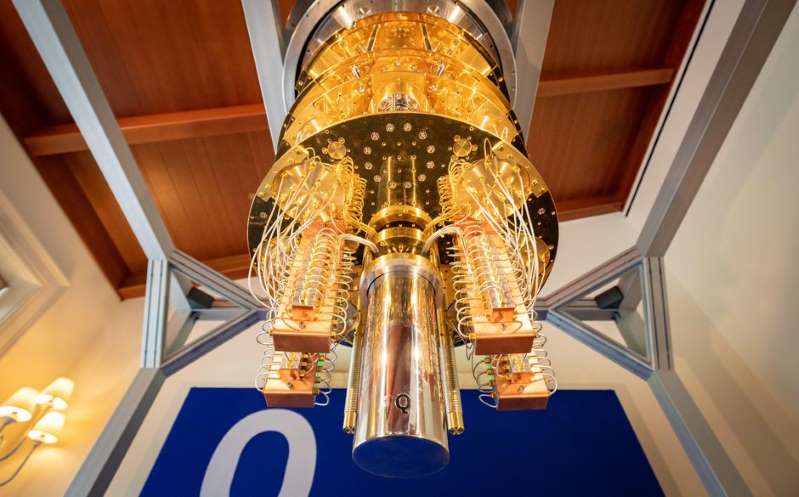
The Science Behind Quantum Computers
Our world is dominated by computers small enough to fit in a pocket. Though, a new form of computing called “quantum computing” is on the rise. Moore’s law (an annual doubling of computing density) is beginning to wane, as humanity reaches the physical limits of classical computing. Quantum computing stands to reaccelerate computing advancement. It will bring a major shift in how computing works and technological capabilities never seen before.
IBM promises 100x faster quantum computers through new software foundations (msn.com)
Classical computing works off a logical system called “binary”. Transistors provide the computer outputs of 1s and 0s, known as “bits”, which are read as true or false statements. This logical system is fundamental to all computer technology we see today. Yet, quantum computing uses a concept that is stranger and more efficient, by more than just a bit. Quantum computers leverage the physics of subatomic particles, known as quantum physics, to read “qubits”. Qubits, rather than holding one of two positions like bits, are capable of superposition. Simply put, qubits can hold a range of various states all at once (1). Qubits can also become entangled with other qubits, forming a multidimensional processing network (1). This allows quantum computers to solve problems in a lateral fashion, where different possibilities are considered at the same time.
Quantum computing is in position to overhaul multiple industries. Physics simulations, chemical compositions, genetic sequences, material structures, and more will be easily processed by quantum computers. Quantum computers will arrive at solutions that are faster and better than anything classical computers can provide (1). Furthermore, the fields of machine learning and artificial intelligence will vastly increase in performance (1). A big ongoing test of quantum computing’s problem-solving ability regards trade. Exxon has teamed up with IBM to optimize shipping networks through quantum computing (2).
Currently, all major tech companies invest heavily into quantum computing, with Google, Intel, Microsoft, and IBM being among them. IBM is the current industry leader, looking to make the jump from a 27 qubit computer to a 1121 qubit computer (3). They are making their software and supply chain open source, to allow for easy parallel development throughout industry (3). The current hope of IBM is that quantum computing will be “frictionless” for developers by 2025 (4).
Despite the advantages of quantum computing, there are cold realities that must be faced. Due to the experimental nature of the technology, results are largely inconsistent. It is estimated by industry experts that it may be 5 to 10 years before consistent results are reached (1). Additionally, quantum computers require extreme conditions to operate. They are kept at a cold .015 degrees Kelvin (nearly absolute zero) and must be shielded up to 50,000 times the Earth’s magnetic field (1). Due to these factors, quantum computers are more likely to be rented out as a service than sold as industrial machines; let alone be sold for personal use.
It is quite possible that quantum computers still have a long road ahead and are decades away from reaching peak performance. This was much the case for classical computers, with them taking decades to truly advance. Yet, quantum computers are a future reality, whether that future comes sooner or later. Furthermore, whatever future reality quantum computers exist in, it will be quite unlike anything we see today.
Sources:
The CIO’s guide to quantum computing | TechRadar
IBM and ExxonMobil are building quantum algorithms to solve this giant computing problem | ZDNet
IBM promises 100x faster quantum computers through new software foundations (msn.com)
IBM is aiming for 'frictionless' quantum computing by 2025 - Compsmag