What Are Semiconductors?
The world of the 21st century has been defined by rapid advances in software and computing technology. Much credit is given to Moore’s Law, where we see a doubling in transistor density among new computers each year. However, a critical component that is often overlooked is the advancement in material science that brought us modern computing: semiconductors. Semiconductors are a special material that enables our computer circuits to function. Without the key advancement of semiconductors, much of our electronic technology would not be able to exist.
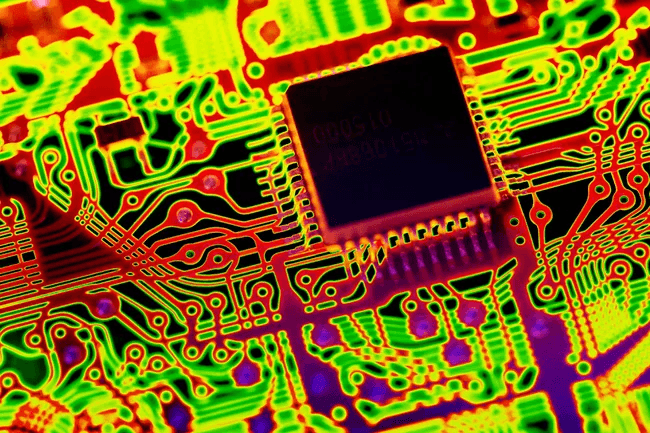
How Semiconductors Work (lifewire.com)
Usage of semiconductor materials are widespread, being built into, “integrated circuits, microchips, transistors, and many sensors” (1). The materials used to create semiconductors are also quite varied: silicon, germanium, gallium arsenide, and silicon carbide are just a few of the materials used (1). Silicon is the most common semiconductor, due to it being quite abundant. If you go to a beach that is covered with sand, you are looking at a wealth of silicon. Regardless of semiconductor material, the appeal of semiconductors is that their electrical conductivity polarity can easily be manipulated. The variation in semiconductor electric current is core to creating any kind of logic-processing system.
The reason why elements like silicon, carbon, and germanium are ideal semiconductors is due to their electron orbitals. Each of these materials have 4 electrons, which make them great at forming covalent bonds with crystal structures (2). Unlike the free electron clouds of metallic bonds, the electrons in crystal covalent bonds are practically locked in place (2). They act as insulators that do not conduct electric current. However, these insulative materials can be “doped” with structural impurities by other materials, to be able to conduct some electrons (2). This is how these nonconductive insulators can become semiconductors.
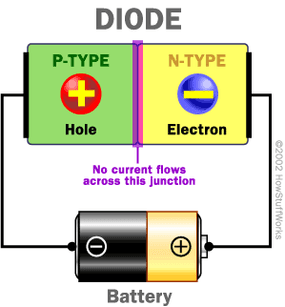
When an insulator like silicon is doped with phosphorous or arsenic, which have five electrons, a free electron becomes present in silicon’s crystal lattices (3). Thus, silicon becomes negatively charged when conducting electricity, and is known as an “N-type” semiconductor (3). If silicon is doped with boron or gallium, which have three electrons, there is a gap of an electron in the silicon lattices. Thus, the lattices become positively charged when conducting electricity, and are known as a “P-type” semiconductor (3). Combining these types of semiconductors in various ways allows for unique circuit behavior.
How Semiconductors Work | HowStuffWorks
The simplest example of a semiconductor circuit is a diode, such as in the image above. When a P-type and N-type semiconductor are combined in sequence, electricity from a battery will only flow in one direction — from positive to negative (3). This is due to the polarity of the charges in the semiconductor materials. If a battery is reversed in its placement, with positive-to-positive and negative-to-negative? Electricity will not be able to flow, due to the electron charges repelling one another. Such a device is incredibly useful and can protect devices from being damaged by something like a misplaced battery (3).
In addition to diodes, semiconductors can also be used to create transistors. These are formed via NPN and PNP semiconductor sandwiches (3). While a large current cannot normally flow straight through a semiconductor sandwich, due to the opposing polarities? If a small current is pushed through the center of the semiconductor sandwich, the polarity of the sandwich can be changed to PPP or NNN — thus, allowing a large current to flow (3). This allows for switching functions — otherwise known as binary “1s and 0s” — which is a fundamental concept to designing machines that can process logic. Without it, computers would not exist.
Electronic technologies today are heavily dependent upon the science of semiconductors. Over the years semiconductor chemistries have been refined, allowing for electronic devices that can hold thousands upon thousands of logic transistors within their circuits. Moreover, simpler technologies like LED lights or microwaves are also reliant upon semiconductors. The science of semiconductors is incredibly interesting, and the world they have provided us is even more so.
Sources:
How Semiconductors Work (lifewire.com)
How Semiconductor Works | Properties, Types & Uses of Semiconductor (electronicsandyou.com)
How Semiconductors Work | HowStuffWorks